Este curso está diseñado para los alumnos sin conocimientos previos de inglés. El Curso de Iniciación te llevará a un nivel de inglés suficiente para entender y hacerte entender en inglés con expresiones elementales y un vocabulario básico, así como te proporcionará la base para poder proseguir con facilidad con el Curso Básico de La Mansión del Inglés.
El curso se ha enfocado desde un punto de vista práctico. Los conocimientos se van adquiriendo al mismo ritmo de una persona real que también se está iniciando en el inglés.
El Curso incorpora, además de la teoría y gramática, imágenes, audio, actividades y ejercicios resueltos así como consejos para facilitar el aprendizaje.
El Curso de iniciación al inglés se compone de: 10 LECCIONES
Lección 1 En esta lección aprenderás:
– A presentarte.
– Los pronombres personales (yo, tú, él…) en inglés y el presente del verbo To be (uno de los más importantes en inglés)
– Preguntar por un objeto
– Los números del 1 al 10
… y mucho más. Lección 2
En esta lección aprenderás:
– A preguntar por el origen / nacionalidad de alguien.
– Que en inglés, muchas veces las palabras se pronuncian con más fuerza en alguna de sus sílabas.
– Que en inglés no existen los acentos y que algunas palabras son muy similares a su equivalente en español. (¡qué bien!)
– El pronombre personal y posesivo en inglés suele variar (She / her – He / his)
– Los números del 10 al 20
… y mucho más.
Lección 3
En esta lección aprenderás:
– A preguntar por el trabajo o actividad de alguien.
– La afirmación y la negación en inglés.
– A formular preguntas y decir respuestas cortas.
– Los números del 20 al 30
… y mucho más.
Lección 4
En esta lección aprenderás:
– Como se usa la posesión (o genitivo sajón) en inglés.
– Que en inglés, normalmente el adjetivo precede al sustantivo (coche rojo = «red car» y no «car red»)
– El presente de otro de los verbos más importantes en inglés: ‘To Have’.
– A pronunciar el alfabeto en inglés.
… y mucho más.
Lección 5
En esta lección aprenderás:
– Que en inglés, los gentilicios se escriben siempre con mayúscula.
– La estructura básica general de los verbos en inglés en presente en sus formas afirmativa, negativa e interrogativa.
– Que al pronunciar frases en inglés algunas palabras se escuchan «encadenadas».
– La regla para utilizar «a» y «an» y los casos especiales de excepción de la misma.
– Los números (decenas) del 30 al 100
… y mucho más.
Lección 6
En esta lección aprenderás:
– Que los verbos en tercera persona suelen añadir una «s».
– Que «do» se emplea como auxiliar del verbo principal para hacer preguntas y que su forma negativa es «don’t».
– A decir buenos días, buenas tardes y buenas noches en inglés.
– Tres preposiciones cuyo uso es un poco confuso para los hispanohablantes: «in», «at» y «on»
… y mucho más.
Lección 7
En esta lección aprenderás:
– Más usos del auxiliar «do» en frases afirmativas, preguntas y negaciones.
– El uso de tres adverbios de frecuencia muy habituales («never», «usually», «sometimes»).
– A distinguir cuándo se usa «when», «why», «where» y «how» en las preguntas.
… y mucho más.
Lección 8
En esta lección aprenderás:
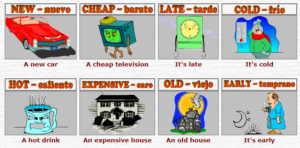
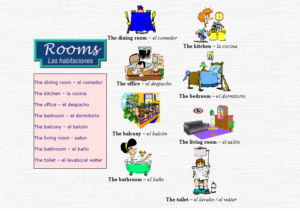
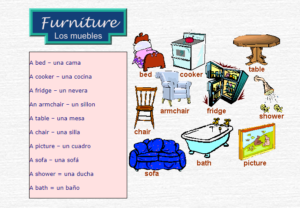
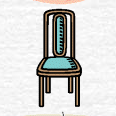
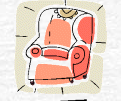
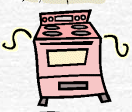
– Vocabulario específico de la casa y el mobiliario.
– El uso de «any» para preguntas y frases en negativo.
– Que existen palabras en inglés que tienen un mismo significado (sinónimos) o diferentes expresiones con un sentido similar.
– Los colores básicos.
– A distinguir cuando señalamos entre uno o varios objetos (there is, there are…)
… y mucho más.
Lección 9
En esta lección aprenderás:
– A preguntar por la fecha de nacimiento y a emplear «who».
– La forma de pasado del verbo «To be».
– Nuevos adjetivos en inglés.
– A completar un formulario básico o elaborar una lista de la compra.
– Cómo pedir y ofrecer cosas en inglés.
… y mucho más.
Lección 10
En esta lección aprenderás:
– Vocabulario específico de los alimentos.
– A interpretar una carta o postal y redactar un email.
– A afianzar conceptos clave en la formulación de preguntas y respuestas.
… y mucho más.
What’s your name? ¿Cómo te llamas? / ¿Cuál es tu nombre?
Hello = hola I’m = I am (yo soy, soy) My name’s = my name is (mi nombre es) What’s = What is (cuál es)
Completa
– Hello, I’m . What’s your name?
– My name’s
PUNTO
En inglés, para decir ‘yo’ se escribe siempre ‘I’ (con mayúscula), independientemente del lugar que ocupe en la frase.My name’s Craig and I am a teacher -> Me llamo Craig y soy profesor.Fíjate también en el ejemplo anterior que en inglés el pronombre personal (I) se utiliza siempre, a diferencia del español, en que el pronombre personal (yo) no siempre es necesario.I’m Luis. I’m Spanish -> (yo) Soy Luis. (yo) Soy español.
¿Has observado que en ocasiones se utiliza un apóstrofo (‘) para abreviar palabras?I am -> I’m
My name is -> My name’sEsta forma gramatical se denomina contracción y es una característica del idioma inglés. Aprenderás su uso progresivamente, aunque como norma general podemos avanzarte que se utilizan habitualmente en el lenguaje hablado y en la forma escrita informal. En escritos formales es más adecuado utilizar las formas no contraidas.
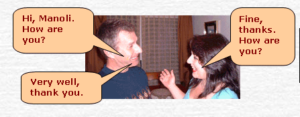
Fine thanks = bien, gracias Very well = muy bien Thank you = gracias
¿Te has dado cuenta de que en inglés las palabras no se pronuncian como se escriben?
A continuación hay una lista de palabras y cada una tiene el mismo sonido vocal:
I’m – fine – Hi
En inglés, el sonido de algunas palabras se une y no se oyen como dos palabras separadas, sino como una.
Elige ‘am’, ‘is’ o ‘are’ en las siguientes frases:
1. I Luis. 2. What your name? 3. This Manoli. 4. How you? 5. I fine thanks.
Escribe las palabras que faltan en las siguientes conversaciones.
‘Yo’ se dice en inglés ‘I’-> Yo soy Juan / I am Juan ‘Tú’ se dice en inglés ‘You’-> Tú eres María / You are María ‘Él’ se dice en inglés ‘He’-> Él es Victor / He is Victor ‘Ella’ se dice en inglés ‘She’ -> Ella es Laura / She is Laura
Para indicar objetos o animales usamos ‘It’-> Es una mesa / It is a table. ‘Nosotros’ se dice en inglés ‘We’-> Nosotros somos americanos / We are American ‘Vosotros’ o ‘ustedes’ se dice en inglés ‘You’-> Ustedes son profesores / You are teachers ‘Ellos’ (y también ‘ellas’) se dice en inglés ‘They’ -> Ellos son españoles / They are Spanish
SINGULAR
PLURAL
I (yo)
we (nosotros, nosotras)
you (tú, usted)
you (vosotros -as, ustedes)
he (él) / she (ella) / it (ello)
they (ellos, ellas)
Lee Tambien
‘You’ equivale a los pronombres españoles ‘tú’, ‘usted’, ‘vosotros’, ‘vosotras’, ‘ustedes’ (debemos determinar a qué forma pertenece por el contexto de la frase).
En la tercera persona singular encontramos las formas ‘He’ (se utiliza esencialmente para referirse a personas del género masculino), ‘She’ (se emplea esencialmente para referirse a personas del género femenino) e ‘It’ para el género neutro (objetos, cosas, animales, etc.). Existen algunas excepciones. Así, en el caso de los animales, cuando queremos personificarlos y dotarlos de sexo masculino o femenino podríamos emplear ‘he’ o ‘she’.
______________________________________________
EL VERBO » TO BE «
I
am
fine
CONTRACCION
I am = I’m
He is = He’s
She is = She’s
It is = It’s
We are = We’re
You are = You’re
They are = They’re
He
She
It
is
We
You
They
are
Las siguientes palabras no están en el orden correcto. Cambia el orden de las palabras para hacer frases y preguntas apropiadas.
1. is your name what 2. is Ruben this 3. you are how 4. well you thank very 5. is name Manoli my
ADJETIVOS POSESIVOS
My name’s Manoli.
What’s your name?
Pon las siguientes frases en el orden correcto:
– Hi Angeles!
– Hello. I’m Craig. What’s your name?
– My name’s Angeles.
1.
2.
3.
– Fine, thanks. How are you?
– Very well, thank you
– Hi Angeles. How are you?
a computer / a hamburger / a football / a car / a dog
a camera / a sandwich / a phone / a television / a book
a computer = un ordenador (amer. computadora) a hamburger = una hamburguesa a football = un balón (de fútbol) a car = un coche, un automóvil a dog = un perro a camera = una cámara a sandwich = un emparedado, un sándwich a phone = un teléfono a television = un televisor, una televisión a book = un libro
Ahora veamos algunos ejemplos con los números ordinales. Ten en cuenta que estos números se pueden usar como sustantivos (como en el primer ejemplo) o como adjetivos (como en el segundo ejemplo).
EJEMPLOS
My baby brother can count tofive.
Mi hermanito sabe contar hasta cinco.
I havethreeapples andtwooranges.
Tengo tres manzanas y dos naranjas.
Números ordinales
Los números ordinales (ordinalnumbers) definen la posición de algo o alguien en una serie. Se usan mucho para hablar de los lugares en una carrera o concurso. Veamos cómo se dicen estos números en inglés. En la primera columna de la tabla se ven los nombres completos de los números ordinales, y en la segunda columna se ven sus abreviaturas.
Existen palabras en inglés con una sola sílaba. Ejemplo: Spain, book, car…
Hay palabras con dos sílabas o más: ·football (2 sílabas) -> foot-ball ·sandwich (2 sílabas) -> sand-wich ·television (4 sílabas) -> te-le-vi-sion
Algunas sílabas se pronuncian más fuerte que las demás.
Where are they from? ¿De dónde son ellos?
Lee
Her name’s Maria. / Su nombre es Maria.
She’s from Argentina. / Ella es de Argentina
His name’s Alejandro. / Su nombre es Alejandro.
He’s from Brazil. / Él es de Brasil.
Rellena los espacios en blanco.
His name’s José
He’s Chile
He’s = he is (él es) She’s = she is (ella es)
name’s Ana
She’s from Peru
name’s Sonia
‘ from Mexico
His name’s Juan
‘ from Venezuela
En inglés existen también algunas palabras que pueden escribirse igual o de forma muy parecida al español, como has visto por ejemplo en el ejercicio anterior (‘Chile’, ‘Venezuela’, etc.) aunque su pronunciación puede variar.
A diferencia del español, en inglés no existen los acentos ortográficos (Perú ‘Peru’)
El posesivo español ‘su’ en inglés es distinto dependiendo del género (masculino o femenino)
Se emplea ‘Her’ como posesivo ‘su’ (de ella) y ‘His’ como posesivo ‘su’ (de él)
Su nombre es Ana -> Her name’s Ana
Su nombre es Juan -> His name’s Juan
Fíjate en la diferencia
Su nombre es Ana. Ella es de Perú -> Her name’s Ana. She‘s from Peru Su nombre es Juan. Él es de Venezuela -> His name’s Juan. He‘s from Venezuela
Traduce al español.
1. Where’s he from? 2. What’s your name? 3. My name’s Luis 4. His name’s Alejandro 5. She’s from Brazil. 6. His name’s Rubén. 7. Her name’s Ana. 8. Where’s she from? 9. How are you? 10. Where are you from?
Ahora relaciona las respuestas con las preguntas, siguiendo el ejemplo.
Ej). Where’s he from?
What’s your name?
How are you?
Where are you from?
What’s her name?
Where’s she from?
Completa las frases con his, her, he’s, she’s.
Ej.) His name’s Craig. from London.
1. Her name’s Manoli. from Valencia. 2. His name’s Rubén. from Valencia. 3. name’s Sonia. She’s from Mexico. 4. His name’s Juan. from Venezuela. 5. name’s José. He’s from Chile. 6. name’s Ana. She’s from Peru. 7. His name’s Harry. from Helsinki. 8. Her name’s Angeles. from Spain
This is Melanie Griffith and Antonio Banderas. Melanie is from the United States and Antonio is from Málaga in Spain.
In this photograph they are in Hollywood. They are married. Antonio is an actor and Melanie is an actress.
Their houses are in Los Angeles, Aspen and Marbella, Spain
Escribe ‘is’ o ‘are’ en las siguientes frases.
1. Melanie from the United States. 2. They married. 3. Melanie an actress and Antonio an actor. 4. Their houses in Los Angeles, Aspen and Marbella, Spain. 5. Antonio from Málaga in Spain.
Observa lo que ocurre con el orden de las palabras cuando hacemos
preguntas en inglés.
Ahora cambia el orden de las siguientes palabras para hacer preguntas sobre Melanie y Antonio.
1. Melanie where is from?
Where from?
2. married they are?
married?
3. are houses their where?
their houses?
4. From Antonio is where?
from?
Lee
Punto
En inglés, los signos de interrogación ‘?’ y exclamación ‘!’ solamente se colocan al final de la frase (a diferencia del español, en que se ubican al comienzo y al final de la frase).
¿Cómo te llamas? -> What’s your name? ¡Vaya día! -> What a day!
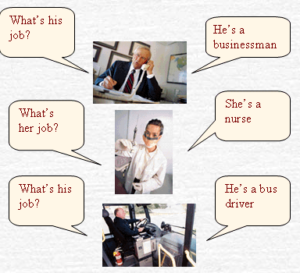
a teacher / a bus driver / a doctor / a secretary / a student / a nurse
a shop assistant / a businessman / a housewife / a barman
En inglés, las profesiones se preceden de los artículos ‘a’ o ‘an’(‘un’, ‘una’ indistintamente), dependiendo de que el sustantivo (nombre de la profesión) comience por el sonido de una consonante o vocal.
My sister is a nurse ->Mi hermana es enfermera.
I’m an engineer ->Soy ingeniero. Your brother is a student -> Tu hermano es estudiante.
Lee la siguiente información sobre Wayne Brown.
Name
AddressCountry
Phone number
Age
Profession
Married
Wayne Brown
21 Coronation Street
Detroit
Michigan
USA
715 238 5146
32
Teacher
No
Address = Dirección Country = País Phone number = Número de teléfono Age = Edad
Completa los espacios en las siguientes preguntas y respustas.
1. ’s his name?
Wayne Brown
2. Where’s he ?
USA
3. What’s address?
21 Coronation Street, Detroit, Michigan
4. What’s his ?
715 238 5146
5. How old is he?
He’s
6. What’s job?
’ a
7. Is married?
No, he isn’t.
AYUDITA Isn’t = is not (no es) Married = Casado/a (marriage = matrimonio) How old is he? = ¿Cuántos años tiene? / ¿Qué edad tiene?
NEGATIVO
Sonia isn’t a nurse / Sonia no es enfermera.
She isn’t married / Ella no está casada.
She isn’t from Argentina. / Ella no es de Argentina
Is Sonia a nurse? – No, she isn’t. / ¿Sonia es enfermera? – No, no lo es.
Is she married? – No, she isn’t. / Está casada? – No, no lo está.
Is she from Argentina? – No, she isn’t. / ¿Es de Argentina? – No, no lo es.
Manoli contestando preguntas personales.
Is your name Manoli?
Yes, it is.
Negativo
I’m not = I am not (No soy)
Where are you from?
I’m from Spain.
Are you from Madrid?
No, I’m not. I’m from Valencia.
What’s your address?
14 Calle del Mar
What’s your phone number?
96 468 35 29
How old are you?
42
What’s your job?
I’m a housewife.
Are you married?
Yes, I am.
En inglés, no es normal contestar a una pregunta con un escueto ‘Sí’ o ‘No’ (yes / no).
Sonaría poco amable. Lo mejor es ampliar la respuesta incluyendo el pronombre personal y el verbo principal de la pregunta.
Are you from Madrid? Yes, I am / No. I’m not Is he an engineer? No, he’s not / Yes, he is
Completa las siguientes preguntas sobre Manoli. Sigue el ejemplo.
Ej. your name? My name’s Manoli.
you from?
I’m from Spain
married?
Yes, I am
How old you?
I’m 42
job?
I’m a housewife
phone number?
96 4683529
________________________________________________
Lee la trascripción, escucha y repite.
– Hello Luis – Hello Craig
– Where are you from? – I’m from Spain
– Are you from Barcelona? – No, I’m not. I’m from Valencia.
– How old are you, Luis? – I’m 42
– What’s your phone number? – It’s 96 4683529
– What’s your job? – I’m a computer technician.
– Really! Are you married? – Yes, I am.
completa la información que falta sobre él.
Name
Country
City
Age
Phone number
Job
Married?
Lee la trascripción, escucha y repite.
– Hello Angeles – Hi
– Where are you from? – I’m from Spain
– Are you from Madrid? – No, I’m not. I’m from Valencia.
– How old are you, Angeles? – I’m 46
– Sorry? – I am 46.
– What’s your phone number? – It’s 96 2957341
– What’s your job? – I’m a dentist.
– A dentist? Are you married? – No, I’m not.
Name
Country
City
Age
Phone number
Job
Married?
I’m from… para indicar de dónde eres.
I’m from Venezuela -> Soy de Venezuela
I’m from Caracas -> Soy de Caracas
Mira la foto de la familia de Manoli. Lee el texto y escucha.
This is Manoli’s family. They are from Valencia, Spain.
Manoli has a husband and his name’s Luis. Their house is in Valencia. Luis and Manoli have a son. His name’s Rubén and he’s 18. Rubén is a student at university. Rubén’s university is in Valencia.
Manoli’s mother is Emilia . She’s 77. Manoli’s father is Felipe. He’s 78. Emilia and Felipe are Manoli’s parents. They have a house in Valencia.
La ‘s posesiva
Manoli‘s family = La familia de Manoli
‘s se usa normalmente para expresar posesión.
Manoli’s mother = La madre de Manoli
– ¡Cuidado!. No lo confundas con la contracción de ‘is’.
His name‘s Rubén (name is) = Su nombre es Rubén.
He‘s 18 (he is 18) = (Él) Tiene 18 años.
– Pero:
Rubén’s university = La universidad de Rubén.
AYUDITA
family = familia husband = marido son = hijo student = estudiante mother = madre father = padre parents = padres have = tienen has = tiene house = casa
_____________________________________________
Contesta las preguntas sobre el texto anterior.
1. Is Luis Manoli’s husband? 2. Is Rubén a teacher? 3. Where is Manoli’s house? 4. Where is Rubén’s university? 5. What’s Manoli’s father’s name? 6. What’s her mother’s name? 7. How old is Manoli’s father? 8. How old is her mother?
where? = ¿dónde?
______________________________________________
Craig’s family
Lee el texto
This is Craig’s family. They are from London, England.
Craig has a sister. Her name’s Stephanie and she’s 49. Craig’s mother is 73. Her name’s Frances. His father’s 72. His name’s Harry. They have a big house in Spain.
big = grande
Completa la siguiente tabla con la información del texto anterior sobre la familia de Craig.
NAME
AGE
Craig’s mother
Craig’s father
Craig’s sister
¿Has observado que el adjetivo (big) precede al nombre?
En inglés suele ser habitualmente así, mientras que en español es generalmente al revés.
My name’s Stephanie. I’m from London. I’m 49 and I’m a housewife.
My father’s name’s Harry. He’s 72. My mother’s name’s Frances, and she’s 73. Frances is Harry’s wife. They have a big house in Spain. Frances and Harry are my parents and I am their daughter. They have two children.
I have a brother. His name is Craig and he’s a teacher in Valencia. He’s 41. I’m Craig’s sister.
I’m married. My husband’s name is Terry and he has a good job.
AYUDITA
wife = mujer, esposa parents = padres
sister = hermana daughter = hija children = niños brother = hermano husband = marido, esposo good job= buen trabajo
Elige la palabra correcta para cada frase.
parents / children / brother / daughter / father / sister
mother / son / husband / wife
1. Frances is Harry’s 2. Craig is Stephanie’s 3. Terry is Stephanie’s 4. Frances is Stephanie’s 5. Craig is Harry’s 6. Stephanie is Craig’s 7. Stephanie and Craig are Frances and Harry’s 8. Frances and Harry are Craig and Stephanie’s 9. Stephanie is Frances and Harry’s 10. Harry is Craig’s
Elige ‘has’ o ‘have’ en las siguientes frases siguiendo el ejemplo.
Manoli a son. His name’s Rubén
1. My wife a good job. 2. I a computer. 3. We a house in the city. 4. They an American car. 5. My sister two dogs. 6. Craig a sister. 7. Our house five rooms. 8. They a book. 9. Her daughter three children. 10. We a new phone.
the city = la ciudad our = nuestro/a
rooms = habitaciones new = nuevo
‘Spell’ tiene principalmente el sentido de ‘deletrear’.
Como habrás visto, a diferencia del español, en inglés las palabras tienen generalmente una pronunciación diferente a su forma escrita. Por ello suele emplearse el recurso de deletrear las palabras (sobre todo apellidos, lugares geográficos y términos que puedan resultar desconocidos) para identificarlas con certeza.
Escribe palabras en ingles
1.
2.
3.
4.
5.
6.
7.
8.
9.
10.
Escribe el término equivalente en inglés de la siguiente relación de palabras. La primera letra ya está escrita para ayudarte.
1. esposa, mujer
2. hermano
3. esposo, marido
4. madre
5. hijo
6. hermana
7. hijos
8. padres
9. hija
10. padre
PUNTO
El plural en inglés generalmente se forma añadiendo una ‘s’ al final de la palabra brother -> brothers (hermano / hermanos) daughter -> daughters (hija / hijas)
Pero no siempre es así. En inglés, algunas palabras tienen un plural irregular.
wife -> wives (esposa / esposas)
son -> children (hijo / hijos)
– Manoli, do you speak Portuguese? – No, I don’t.
– Do you speak French? – A little.
– Do you speak German? – No, I don’t.
– Do you speak Spanish? – Yes, I do.
– Do you speak English? – Yes, a little.
To speak = hablar Do you speak… ? = ¿hablas…? A little = un poco Don’t = do not (negativo)
A diferencia del español, en inglés, los gentilicios (nombres que expresan el origen geográfico) se escriben siempre con mayúscula. Spain -> España -> I’m from Spain / Soy de España Spanish -> español -> I’m Spanish / Soy español
Italy -> Italia -> You are from Italy / Eres de Italia
Italian -> italiano -> You speak Italian / Hablas italiano
Hi! I’m Rubén and I’m Spanish. I live in Valencia, Spain.
I’m a student and I study communication technology in Valencia. I’m 18 and I’m not married. I live with my parents in a flat. We don’t have a house and I don’t have any brothers and sisters.
My mother’s name’s Manoli. She’s a housewife.
I live = vivo I study = estudio communication technology = telecomunicaciones a flat = un piso, apartamento
A o AN
Se usa ‘a’ delante de una consonante /b/, /c/, /d/, /f/ etc.
Ej. a pizza, a coke, a flat
Se usa ‘an’ delante de una vocal /a/, /e/, /i/, /o/, /u/.
Ej. an ice cream, an animal, an apple
Cuando a un sonido de vocal le sigue un sonido de consonante, es usual que ambos se junten.
Escribe las palabras que faltan en las siguientes frases. Sigue los ejemplos.
Ej.) They’re from . They speak / Son de Francia. Hablan francés.
They’re from . They speak . / Son de Estados Unidos. Hablan inglés.
1. They’re from México. They speak . 2. They’re from Portugal. They speak . 3. They’re from Italy. They speak . 4. They’re from Canada. They speak . 5. They’re from Spain. They speak . 6. They’re from Brazil. They speak .
zero – cero one – uno two – dos three – tres four – cuatro five – cinco six – seis seven – siete eight – ocho nine – nueve ten – diez eleven – once twelve – doce thirteen – trece fourteen – catorce fifteen – quince sixteen – dieciséis seventeen – diecisiete eighteen – dieciocho nineteen – diecinueve twenty – veinte
Ahora intenta recordar y decir los números del 21 al 30.
twenty-one
21
twenty-six
26
twenty-two
22
twenty-seven
27
twenty-three
23
twenty-eight
28
twenty-four
24
twenty-nine
29
twenty-five
25
thirty
30
Relaciona los números del 30 al 100.
30
70
40
80
50
90
60
100
Cada cuadro representa una sílaba. El cuadro mayor representa el ‘stress’ (acento) de la palabra. Fíjate como cambia el stress. ¿Cuáles son los números que tienen el stress en la primera sílaba y cuáles son los que tienen el stress en la segunda?
Para expresar las cifras en inglés, el punto se utiliza como separador decimal y la coma indica las unidades de millar (al revés que en español).
103.17 (ciento tres con diecisiete)
10,215 (diez mil doscientos quince)
1,432.25 (mil cuatrocientos treinta y dos con veinticinco)
En USA, la moneda es el dólar (‘dollar’) que se divide en 100 centavos de dólar (‘cent’).
En el Reino Unido, la moneda es la libra (‘pound’) que se divide en 100 peniques (‘penny’, en plural ‘pence’)
Luis is 43. He lives with his family in Valencia.
Luis is the webmaster of La Mansión del Inglés, and he works as a computer technician.
he lives = él vive he works =él trabaja
Lee sobre un día corriente de Luis y relaciona las frases con las imágenes. Sigue los ejemplos. Utiliza el cuadro de ayuda para conocer el significado de las palabras nuevas.
1
2
3
4
5
6
7
8
9
to listen to the radio = escuchar la radio to have breakfast = desayunar to have lunch = comer to have dinner =cenar
to go to work = irse a trabajar to get home = llegar a casa to go to bed = irse a la cama at 7 o’clock =a las siete en puntp
Lee las siguientes frases y escribe el verbo que falta, siguiendo el ejemplo.
Ej.) I get up at 8 o’clock.
Luis at 7 o’clock.
1. I have dinner with my husband.
Luis dinner with his family. 2. I go to work by bus.
He to work by car. 3. I get home at 6 o’clock.
He home at 4 o’clock. 4. I have lunch at work.
Luis lunch at home.
¿Cómo cambia el verbo
cuando hablamos de ‘he’ / él (she / ella – it / ello)?
El verbo en tercera persona añade la letra final ‘s’.
Observa la conjugación del verbo ‘To work’ (trabajar).
I work
You work
He works
She works
It works
We work
You work
They work
_______________________________________________
Cambia el verbo en las siguientes frases siguiendo el ejemplo.
Ej.) We have lunch at work.
Manoli lunch at home.
We live in Madrid. She in Barcelona
They work in a university. Maria at home.
I drink coffee. My wife tea.
eat /I:t/ = comer
I eat chocolate and pizza. Angeles salad.
We like beer and wine. My son vodka.
I want a hamburger. Pablo an ice cream.
_________________________________________________
‘Do’ se emplea como auxiliar del verbo principal para hacer preguntas. La forma negativa es don’t (do not). También se utiliza cuando se contesta en las respuestas cortas. ‘Do’ puede ser también un verbo (‘To do’ = hacer).
Cuidado en las respuestas. Hay que emplear ‘do’ y no el verbo principal. Fíjate en los ejemplos siguientes.
Do you speak English? / Yes, I do (yes, I speak) ¿Hablas inglés? / Sí Do you go to work by bus? / No, I don’t (No, I no go) ¿Vas a trabajar en autobús? / No
What time do you go to bed? ¿A qué hora te vas a la cama? What do you do? ¿Qué haces? (El primer ‘do’ es el auxiliar y el segundo el verbo hacer)
Cuando nos referimos a la tercera persona (‘he’, ‘she’, ‘it’) se emplea ‘does’. En este caso, no se añade la ‘s’ final al verbo principal. La forma negativa es doesn’t (does not). Al igual que con ‘do’, también se utiliza la forma auxiliar en las respuestas cortas.
Fíjate en este ejemplo de una conversación corta como cambia la forma del auxiliar y la del verbo principal (en este caso, ‘hablar’, ‘speak’).
– I’m Luis. I speak Spanish and English.
– Do you speak French?
– No, I don’t
– He’s Paul. He speaks French but he doesn’t speak Spanish.
– Does he speak English?
– Yes, he does
_____________________________________________
Present Simple – Presente de Indicativo(he, she, it)
PositivoHe speaks Spanish
She likes football
NegativoShe doesn’t speak French
He doesn’t like swimming
PreguntaDoes she speak Spanish?
RespuestaYes, she does / No, she doesn’t
El ‘present simple’ se usa para expresar afirmaciones que son generalmente verdaderas o bien hechos o situaciones que ocurren con cierta frecuencia o habitualmente.
This is Angeles. She‘s a dentist and she lives and works in Valencia, Spain. On Mondays and Wednesdays Angeles gets up at 7 o’clock and goes swimming. She has breakfast in a bar and goes shopping. She never gets up late. She usually listens to the radio and sometimes she reads the newspaper.
She has lunch at 2 o’clock and goes to work by bus in the afternoon. She has a car but she doesn’t drive to work.
Angeles gets home late, usually at 9 or 10 o’clock. She has dinner and she sometimes plays ‘spider’ on her computer. She usually goes to bed at 12 o’clock. Sometimes she reads a book in bed.
Lee el texto otra vez y busca los verbos. Escríbelos en el siguiente cuadro. Sigue los ejemplos.
lee el texto de nuevo utilizando el cuadro de ayuda para conocer el significado de las palabras difíciles.
This is Angeles. She’s a dentist and she lives and works in Valencia, Spain. On Mondays and Wednesdays Angeles gets up at 7 o’clock and goes swimming. She has breakfast in a bar and goes shopping. She never gets up late. She usually listens to the radio and sometimes she reads the newspaper.
She has lunch at 2 o’clock and goes to work by bus in the afternoon. She has a car but she doesn’t drive to work.
Angeles gets home late, usually at 9 or 10 o’clock. She has dinner and she sometimes plays ‘spider’ on her computer. She usually goes to bed at 12 o’clock. Sometimes she reads a book in bed.
goes swimming = va a nadar goes shopping = va a la compra never = nunca usually = normalmente but = pero sometimes =a veces late = tarde in bed =en la cama
En las frases afirmativas del presente simple normalmente no se usa el auxiliar ‘do’ o ‘does’ delante del verbo. Sin embargo, la tercera persona añade una ‘s’.You live in Valencia. He lives in London. ->Tú vives en Valencia. Él vive en Londres
En las preguntas y negaciones se utiliza el auxiliar ‘do’ / ‘don´t’ (‘does’ / ‘doesn´t’ para la tercera persona).Do you live in Valencia? / Does he live in London?
No, I don’t. / No, he doesn’t
Con el verbo ‘To be’ (ser, estar) no se utiliza el auxiliar ‘do’ / ‘does’Observa la diferencia:
Where does she live? / She lives in Valencia ->¿Dónde vive ella? / Ella vive en Valencia
Where is she from? / She is from London ->¿De dónde es ella? / Ella es de Londres
Las palabras never, usually y sometimes(nunca, normalmente, a veces) son adverbiales (adverbios de frecuencia). Normalmente van justo delante del verbo.
She never gets up late. / Ella nunca se levanta tarde.
I usually read the newspaper in the morning. / Normalmente leo el periódico por la mañana.
We sometimes listen to the radio. / A veces escuchamos la radio.
Lee las siguientes frases y escribe el adverbio en el sitio correcto (justo delante del verbo). Sigue el ejemplo.
Ej. I read the newspaper (never) I never read the newspaper.
Elige el adjetivo correcto en las siguientes frases. Sigue el ejemplo.
It’s usually in New York in December
1. 6 o’clock in the morning is 2. A Ferrari is a/an car. 3. In August Spain is very 4. My father is 78. He’s an/a man. 5. In Spain, people usually have a dinner. 6. The coffee in Paris is very 7. India is a country to visit. 8. My son has a/an computer.
August = agosto very = muy people = gente, la gente country = país to visit = visitar
Elige la mejor palabra para hacer cada pregunta. Sigue el ejemplo.
is your name?
do you live? are you?. time do you go to work? do you usually have lunch? does she read in bed? does your husband get home? do you do after work? brothers and sisters do you have? do you get up at 6 o’clock? music do you like? old are you? my new radio?
Elige el número correcto para cada frase. Sigue el ejemplo y utiliza el cuadro de ayuda para las palabras que desconozcas.
5 / 60 / 10 / 24 / 9 / 26 / 7 / 11 / 2
There are players in a basketball team – (hay 5 jugadores en un equipo de baloncesto)
There are days in a week.
There are players in a football team.
There are lessons in Manoli’s English course.
There are letters in the English alphabet.
There are minutes in an hour.
There are bedrooms in Manoli’s flat.
There are planets in our solar system.
There are hours in a day.
week = semana letters = letras alphabet = alfabeto planet = planeta solar system = sistema solar
Normalmente utilizamos any para las preguntas y frases negativas.
Are there any chairs in the bedroom? ¿Hay sillas en el dormitorio?
There isn’t any beer! ¡No hay cerveza!
Mira bien los dos fotos. Hay ocho diferencias entre ellas. Hay ocho cosas en la foto A que no están en la foto B.
Escribe las cosas que faltan en la foto B siguiendo los ejemplos
Completa las frases con las palabras más adecuadas. Sigue el ejemplo.
there is / there isn’t / is there? / there are / there aren’t / are there?
Ej. a train at 6 o’clock? / (¿Hay un tren a las 6?)
1. any trains to Cardiff this morning?
2. a train at 8 o’clock.
3. any trains to Ipswich on Sunday.
4. a bank near here?
5. seven days in a week.
6. any chairs in the bedroom.
7. a beer in the fridge?
8. two sofas in the living room.
Escribe las siguientes frases en pasado (PAST SIMPLE). Sigue los ejemplos.
Ej. 1. I‘m married. (I am married) Estoy casado/a. I was married. Estaba casado/a
Ej.2. They are actors. Ellos/Ellas son actores. They were actors. Ellos/Ellas eran actores.
1. Today is Friday. Yesterday 2. I’m a secretary. 3. He isn’t a footballer. 4. They are famous. 5. How much is this T-shirt? 6. George Bush is President of the USA. 7. It’s a new sofa. 8. Are there any pictures on the walls? 9. It’s hot today. 10. We aren’t in Buenos Aires.
Elige el adjetivo correcto en las siguientes frases. Sigue el ejemplo.
Ej. Luis and Manoli are
1. Brazil is a country. 2. Mother Teresa was a person. 3. Denmark is a country. 4. Brad Pitt was , but now he’s to Jennifer Aniston. 5. Thank you for the present. 6. English food is !
single = soltero person = persona present = regalo food = comida
Lee el siguiente formulario que ha rellenado Manoli.
Surname
GARCÍA Mr. / Mrs. / Ms.
registration form =
formulario de matrícula surname = apellido first name = nombre date of birth = fecha de nacimiento postcode = código postal signature = firma
Utilizamos would like para pedir cosas.– I’d like a beer, please. -> Quisiera una cerveza por favor.
– We’d like two coffees. -> Queríamos dos cafés.
*(‘d = would)
También podemos utilizar would like para ofrecer cosas.– Would you like a drink? -> ¿Te apetece beber algo?
– Would you like some more bread? -> ¿Te apetece un poco más de pan?
Utilizamos like para hablar de las cosas que nos gustan y de las que disfrutamos.– I like beer. -> Me gusta la cerveza. (siempre)
– I like playing tennis. -> Me gusta jugar al tenis. (siempre)
– What do you like doing? -> ¿Qué te gusta hacer?
Would like es paracido a want, pero utilizamos would like con gente que no conocemos y para ser más cortés y educado.– I want some more cake! -> ¡Quiero más pastel!
– I’d like some more cake, please. -> Me gustaría un poco más de pastel por favor.

 En la tercera persona singular encontramos las formas ‘He’ (se utiliza esencialmente para referirse a personas del género masculino), ‘She’ (se emplea esencialmente para referirse a personas del género femenino) e ‘It’ para el género neutro (objetos, cosas, animales, etc.). Existen algunas excepciones. Así, en el caso de los animales, cuando queremos personificarlos y dotarlos de sexo masculino o femenino podríamos emplear ‘he’ o ‘she’.





































 This
This